

Haemorrhoids treatment is often needed when symptoms such as bleeding or discomfort begin to affect daily life.
What are haemorrhoids?
Haemorrhoids (piles) are extremely common and are something we are all born with. Everyone has small “anal cushions” inside the back passage, they help maintain control of wind and stool. These cushions only become a problem when they swell or enlarge, leading to symptoms we recognise as haemorrhoids.
Most patients benefit from haemorrhoids treatment when these symptoms become persistent. As an expert haemorrhoid specialist, Mr. Khan focuses on accurate diagnosis and patient comfort.
When haemorrhoids become symptomatic, they may cause bright-red bleeding, itching, discomfort, swelling, or a lump that comes down when opening your bowels. Internal haemorrhoids usually bleed but are rarely painful, while external haemorrhoids can be more sensitive and uncomfortable.
Haemorrhoids are not cancer, do not turn into cancer, and are one of the most frequent reasons people see a colorectal specialist. Symptoms may settle within days with the right advice, although more persistent cases may require treatments such as banding or surgical procedures.
With the correct assessment and management, most people experience significant improvement and long-lasting relief.

What causes haemorrhoids?
Haemorrhoids can develop for a variety of reasons. In most people, they are primary haemorrhoids, meaning they develop on their own without an underlying serious disease. Less commonly, they can be secondary haemorrhoids, caused by another condition that increases pressure in the pelvic or rectal area.
Primary causes of haemorrhoids
These are the common everyday factors that increase pressure on the anal cushions:
- Constipation
- Sitting on the toilet for long periods
- Straining when opening your bowels
- Heavy lifting
- Chronic diarrhoea
- Increasing age (weaker supporting tissues)
Secondary causes (less common)
These are situations where another condition leads to swollen haemorrhoidal tissue:
- A growth inside the rectum (e.g., rectal tumour)
- A large mass in the abdomen causing pressure
- Late stages of pregnancy
- Conditions that raise pressure in the veins (rare)
Haemorrhoids treatment options
Haemorrhoids treatment depends on the type, severity, and symptoms. And also whether these are internal or external haemorrhoids.
1. Lifestyle & Self-Care
These measures can settle symptoms in many cases:
- Increase fibre intake
- Drink more water
- Avoid straining
- Limit time on the toilet
- Improve bowel habits
2. Non-Surgical Treatments
Rubber Band Ligation (Banding)
Rubber Band Ligation is the most common and effective first-line treatment for internal haemorrhoids, typically performed as a quick outpatient procedure in the clinic.
While highly effective, the procedure may cause some mild discomfort or a sensation of fullness, but it is generally well-tolerated and does not mostly require a general anaesthetic. This method is specifically indicated only for internal haemorrhoids.

3. Surgical Treatments
For more severe haemorrhoids or when other treatments fail, following are widely agreed treatments.
THD (Transanal Haemorrhoidal Dearterialisation)
The THD procedure is an advanced, minimally invasive (“keyhole-style”) treatment for haemorrhoids. The operation is performed internally using a specialised Doppler device to accurately locate the blood vessels supplying the haemorrhoids. These vessels are then precisely ligated (tied off).
This modern technique is designed to be gentler than traditional surgery, as no cutting of external tissue is involved in most cases. This typically results in significantly reduced post-operative pain and a faster return to normal activities. THD represents a modern haemorrhoids treatment option with reduced discomfort compared to traditional surgery
For more detailed information on the THD Doppler method, please visit the official THD technique website

Haemorrhoidectomy (Ligasure or conventional)
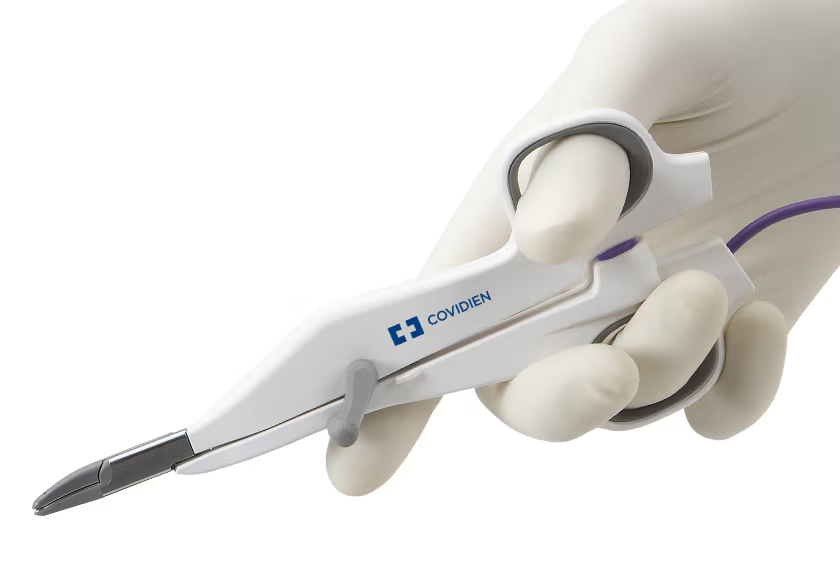
Removal of haemorrhoids by surgically removing them with cutting as standard Milligan Morgan Haemorrhoidectomy or use of a specialist equipement (Picture below) called Ligasure.

Mr. Khan’s Preferred Haemorrhoid Specialist Approach
Mr Khalid Khan preferred treatment approach:
THD is very helpful for patients whose main symptom is bleeding, especially if banding has not helped.
For people with larger haemorrhoids that stay permanently out and when there are noticeable external lumps or skin tags, a Ligasure haemorrhoidectomy is usually the better and more effective treatment.
Further reading
National Institute of Health and Care Excellence (NICE) – THD Info
Information provided is for general guidance and does not replace a personalised consultation.